
01 / Industry
Financial Services and Banking
Regulators scrutinize every model. McKinsey estimates gen AI could add $200 billion to $340 billion a year across banking. Risk work governs credit, fraud, and trading models under tight supervision.

AI Risk Management Consulting
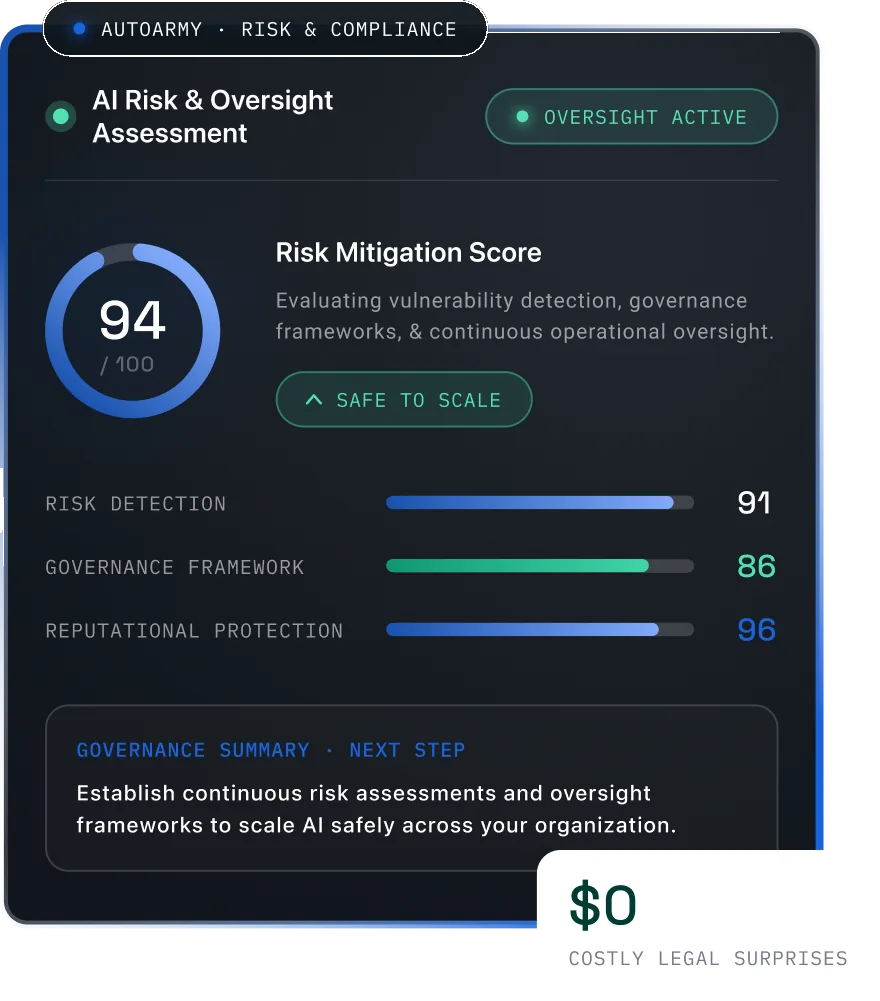
AutoArmy’s AI risk management consulting helps US businesses find, govern, and reduce AI risk. The work runs from assessment to ongoing oversight, so AI scales without costly legal or reputational surprises.
Regulators are done waiting. Under the EU AI Act, banned uses draw fines up to EUR 35 million or 7% of global turnover. One ungoverned system can become a balance-sheet event overnight.
Biased models create legal liability. The EEOC warns that employers stay liable when an AI hiring tool discriminates under Title VII. One unfair output can trigger claims and lasting brand damage.
When AI breaks, who owns it? IBM finds 63% of organizations have no AI governance policies at all. Without clear ownership, risk drifts until an incident forces the question.
Your vendors’ AI is your exposure. Deloitte finds 93% of leaders report low maturity in managing AI risk across third parties. A supplier’s blind spot quietly becomes yours.
Cleaning up beats nothing, but it costs far more. IBM finds breaches involving shadow AI cost $670,000 more than average. Waiting for an incident is the most expensive plan there is.
Trust is hard to win and easy to lose. KPMG finds only 46% of people are willing to trust AI. One public failure can undo years of customer goodwill.
Services
Every engagement stays advisory. We assess your exposure, scope what fits, and guide the controls that keep AI accountable. You own each decision, and the work names real frameworks rather than vague assurances.
Map your AI risk exposure across models, data, and vendors. An AI risk assessment scores likelihood and impact. It flags bias and data privacy gaps, then ranks fixes so you act on the threats that matter first.
Establish a governance framework that holds up under scrutiny. Advisory work aligns AI governance to the NIST AI RMF and ISO/IEC 42001. It defines policies, roles, and review gates, so oversight is built in, not bolted on later.
Align AI to the rules that bind you. Advisory mapping covers regulatory compliance across the EU AI Act, FTC guidance, and sector laws. It closes gaps in data privacy and documentation before an auditor or regulator finds them.
Control risk across every model from build to retirement. Lifecycle governance adds monitoring for model drift, bias, and performance. Documented model risk management means issues surface early, not in front of your customers.
Vet the AI you buy, not just the AI you build. Advisory work assesses third-party risk across vendors and tools, checking their data practices, model controls, and contracts so a supplier’s weakness never becomes your liability.
Monitor AI in production and prepare for the worst case. Advisory design sets key risk indicators, audit trails, and an incident response plan, so a hallucination or breach triggers a fast, documented response, not a scramble.

Next step
Get an independent read on your biggest AI risks and the fastest way to close them.
Industries
Risk looks different in every sector, so advice is shaped to each one. The goal stays constant: AI that is fair, compliant, and accountable.
Regulators scrutinize every model. McKinsey estimates gen AI could add $200 billion to $340 billion a year across banking. Risk work governs credit, fraud, and trading models under tight supervision.

Patient safety raises the stakes. Deloitte finds 75% of leading health companies are scaling gen AI. Risk work governs clinical models under HIPAA and human oversight.

Models now price policies and pay claims. BCG reports insurance leads AI adoption among industries. Risk work checks underwriting and claims models for bias, fairness, and regulatory exposure.

Hiring algorithms carry real liability. The EEOC holds employers accountable for discriminatory AI in selection. Risk work audits recruiting tools for bias before they ever reach candidates.

Public accountability is non-negotiable. Deloitte reports more than half of state CIOs say staff already use gen AI. Risk work brings transparency and audit trails up to standard.

Personalization handles sensitive data. McKinsey puts gen AI’s retail and CPG potential at $400 billion to $660 billion a year. Risk work governs privacy, pricing, and recommendation models.
Advisory comes first, then we connect you with vetted risk specialists, never a generalist firm stretching beyond its depth. You gain senior strategy plus a team proven in AI risk.
Partners are matched to your sector and risk profile, from banking to public sector. That pairing means controls fit your regulators and systems, not a generic template.
Guidance aligns to US frameworks: the NIST AI RMF, EEOC guidance, and FTC rules. You inherit recognized standards instead of a homegrown checklist that fails review.
Pre-scoped matching skips the long search. Because the network is vetted in advance, the right risk team starts in days, not months, so exposure does not linger.
One engagement covers legal, compliance, IT, and HR risk together. That cross-functional view closes the gaps that appear when each function manages AI risk alone.
You get transparent oversight and no long-term lock-in. Advisory stays independent, partners are scoped to the work, and you keep control of every decision and renewal.

Next step
Tell us your concerns. We will map your exposure and match you with the right US risk team.
FAQ
Straight answers to the questions leaders ask most.
It is advisory help that finds and reduces the risks AI creates. AI risk management consulting covers a risk assessment, an AI governance framework, regulatory compliance, model lifecycle monitoring, third-party risk, and incident response. Advisors map your exposure, rank the threats, and design controls. You leave with a clear picture of where AI could hurt you, plus a plan to manage it before it does.
IT risk management protects systems and data; AI risk management adds the risks of models that learn and decide. That layer covers bias, model drift, hallucination, and automated decisions that older frameworks never planned for. The two should connect, but AI brings new failure modes. That extra layer is what addresses unfair outcomes, explainability gaps, and the regulatory exposure unique to machine decisions.
It varies by sector and use. Common references include the NIST AI RMF for risk practices, EEOC guidance for hiring tools, and FTC rules on unfair or deceptive AI. Sector laws like HIPAA for health and fair-lending rules for credit can also apply. Firms serving EU users also weigh the EU AI Act. Advisors map your exact duties early, so controls match the rules you must meet.
Most assessments run a few weeks, depending on how many models and vendors are in scope. A focused review of one high-risk system finishes faster, while an enterprise-wide assessment takes longer. Advisors scope the timeline up front and start with your highest-exposure use cases. You get a ranked risk register and a remediation plan quickly, so the worst gaps close first.
Regulated, decision-heavy sectors need it most: financial services, healthcare, insurance, HR, government, and retail. Each faces strict rules. Most also make high-stakes automated decisions where bias or error carries real cost. That said, any business deploying AI on customer or employee data benefits. The common thread is exposure: the more AI decides, the more risk management matters.
Through partners. AutoArmy is advisory-first and vendor-neutral: we assess your exposure, then match you with vetted risk specialists from our network who fit your sector and systems. We do not sell delivery hours or a single platform. You keep one accountable advisor for strategy, gain a proven team for the work, and approve the partner before anything begins.
Make the right first conversation
Businesses see real AI returns by making fewer wrong decisions early. AutoArmy’s advisory process helps businesses make the right call before the budget is set.